What is tree topping and why is it bad?
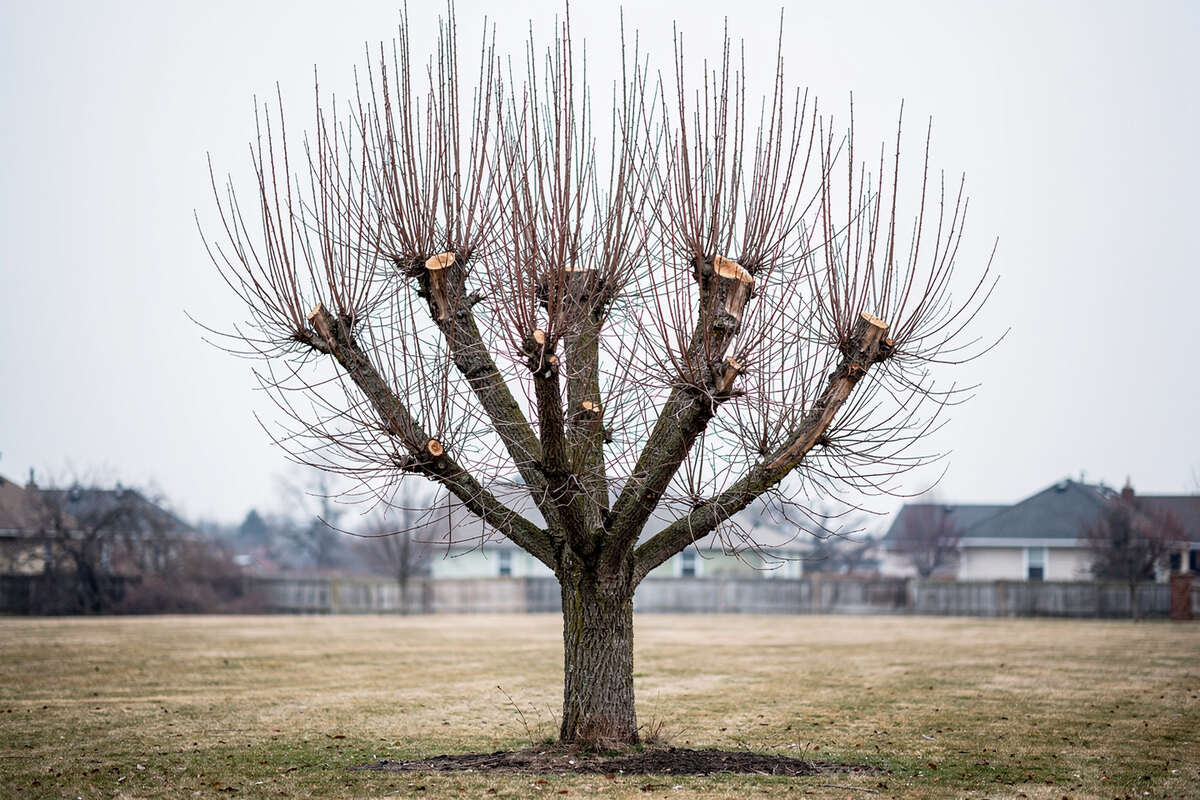
Topping is cutting a tree's main limbs back to stubs at an arbitrary height, ignoring where branches join. It starves the tree, opens large wounds that decay, and triggers dense, weakly attached watersprouts that grow back faster and break more easily. Instead, ask for crown reduction to lateral branches, staying under 25% of the crown, or remove the tree.
Drive through any older neighborhood and you will see them: trees cut into stubby fists, sprouting brooms of thin shoots from every cut. That is topping, the most damaging thing routinely done to trees in the name of care. It is sold as a way to make a big tree safer or smaller. It does the opposite on both counts and costs more over time than proper pruning or removal.
| Topping | Crown reduction | Removal | |
|---|---|---|---|
| What is cut | Main limbs and leader cut to stubs at a set height | Limbs shortened to a lateral branch at least a third their size | Whole tree; stump ground separately |
| Crown removed | Often 50% or more | Under 25%; 10–15% on mature trees | 100% |
| Wounds | Many large stubs with no collar; decay inward | Cuts at branch junctions that can close | None to maintain |
| Regrowth | Dense, weakly attached watersprouts; original height in a few years | Normal, from existing branches | None |
| Safety result | Worse: heavier, more breakable crown on rotting stubs | Better: less weight, sound attachments | Hazard gone |
| Look | Disfigured permanently | Natural outline, slightly smaller | Empty space; plant a right-sized tree |
| Follow-up | Re-cutting every few years, eventual removal | Normal cycle, every 3–5 years | Stump grinding, $100–$400 |
| Who offers it | Untrained crews | Arborists and trained crews | Any tree service |
What does topping a tree mean?
Topping is cutting the main limbs, or the trunk itself, back to stubs at whatever height someone decided on, without regard to where side branches or buds are. The cuts land mid-limb rather than at junctions, leaving a trunk with a few thick, blunt arms. It goes by other names: hat-racking, heading back, rounding over, tipping, "taking the top out." Utility crews sometimes do a version under lines, and a homeowner with a chainsaw and a ladder often does it by accident. The test is simple: if cuts are made at an arbitrary point along a limb instead of just outside a lateral branch or collar, it is topping. Crape myrtles get the same treatment every winter across the South and suffer the same way.
Why is topping bad for trees?
Because it breaks every rule at once. It removes far more than the 25% ceiling in one visit, often half the crown or more, so the tree loses most of its food supply. The stubs have no branch collar and no lateral to take over, so the tree cannot close them, and each becomes a column of decay working down into the limb and trunk. Bark that was shaded is suddenly in full sun and cracks with sunscald. The tree's emergency response, sprouting from dormant buds below each cut, produces dozens of thin shoots attached only to the outer wood of a rotting stub. The topped tree is weaker, more hazardous, and uglier than before, and it is often the start of the decline that ends on the dying-tree page.
Does a topped tree grow back?
Yes, faster than you want and worse than before. Within a year the stubs are crowned with watersprouts, and because the tree is desperate to replace its leaves they can grow several feet a season. In a few years the tree is back to its original height and denser, since every stub carries a cluster of stems where there used to be one. A normal branch is anchored by wood laid down around it year after year; a watersprout is anchored to the outer bark of a stub decaying underneath it. As the sprouts thicken and catch wind, they break. So the tree topped "for safety" is now dropping limbs, and the tree topped "to make it smaller" is the same size with a re-cutting bill every few years.
What should you do instead of topping?
If the goal is a smaller or lighter tree, ask for crown reduction. A reduction cut shortens a limb back to a side branch at least a third of the limb's diameter, so the side branch takes over as the new end and the wound is at a junction the tree can close. Done across the crown and kept under 25% of the live canopy, it lowers and narrows a tree by a few feet while leaving a natural outline. If the goal is less weight over the house, ask for thinning and end-weight reduction on the specific limbs. If the tree is simply the wrong size for the spot, no pruning fixes that; the answer is removal and a replacement that fits, weighed on trim or remove? Removal runs $200–$2,000 for most trees, with stump grinding $100–$400 on top; details on how much does tree removal cost? Removing a tree once is cheaper than topping it every few years and removing it anyway.
How do you know if a company will top your tree?
The clearest sign is that they offer it: "topping," "hat-racking," "we'll take the top out," or a quote that names a height ("cut it back to 20 feet") rather than a plan of specific cuts. Other signs: a proposal to remove more than a quarter of the crown in one visit, photos of trees cut to stubs on the truck or website, spikes on a climber's boots for a pruning job (spikes wound the trunk and are for removals only), and no mention of reduction, lateral, or collar when you ask how they will do it. A company that prunes properly will have an ISA Certified Arborist on staff or on call, can describe which limbs are being reduced and to what, and will tell you when a tree cannot be made small enough and should come out. More warning signs are on tree service red flags.
No independently confirmed professional review is on file yet.
Not yet independently reviewed. Figures are typical US ranges for planning purposes, not quotes.