How do I know if my tree is dead or dying?
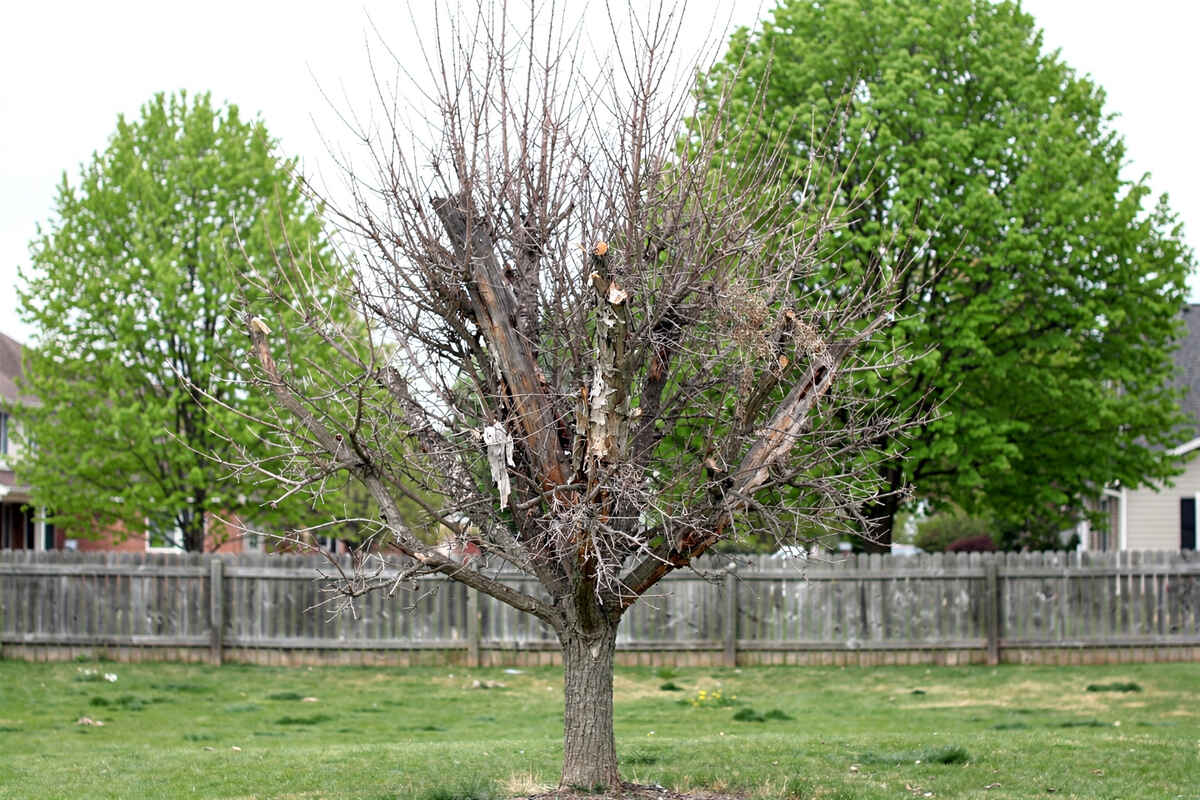
Scratch a small twig with your thumbnail: green and moist underneath means the tree is alive, brown and dry means that branch is dead. Check several branches. A tree with no leaves in summer, bark falling off in sheets, mushrooms at the base, and brittle branches that snap is dead or dying and should be assessed for removal.
Trees die slowly and unevenly, which is what makes this hard. One dead branch does not mean a dead tree. A tree with thin leaves might be stressed by a dry summer and bounce back. But a few signs are reliable, and a couple of them mean the tree is a hazard now regardless of whether it still has some green on it.
Start with the scratch test, then walk around the tree and check it against the table. Photos of each sign help if you call an arborist later.
| What you see | What it usually means | How serious |
|---|---|---|
| Twig scratch test shows brown and dry, all around the tree | Tree is dead | Plan removal |
| No leaves in late spring or summer; buds dry and crumbly | Dead, or nearly | Plan removal |
| Leaves only on one side or on the lower half | Dying from the top or one side; root or trunk damage | Get it assessed |
| Bark peeling off in sheets, bare smooth wood showing | That section is dead | Get it assessed |
| Mushrooms or shelf fungus at the base or on the trunk | Internal decay; base may be hollow | Hazard, especially near a house |
| Deep vertical cracks or a cavity in the trunk | Structural weakness | Hazard |
| Many small dead branches falling in calm weather | Tree is shedding what it cannot support | Get it assessed |
| Sawdust-like material or many small holes in bark | Borers or beetles; tree may already be dying | Get it assessed |
| Sudden lean, lifted soil or roots on one side | Root failure in progress | Emergency |
| Thin canopy but scratch test is green | Stressed, not dead (drought, compaction, construction) | Often recoverable |
What is the scratch test for a dead tree?
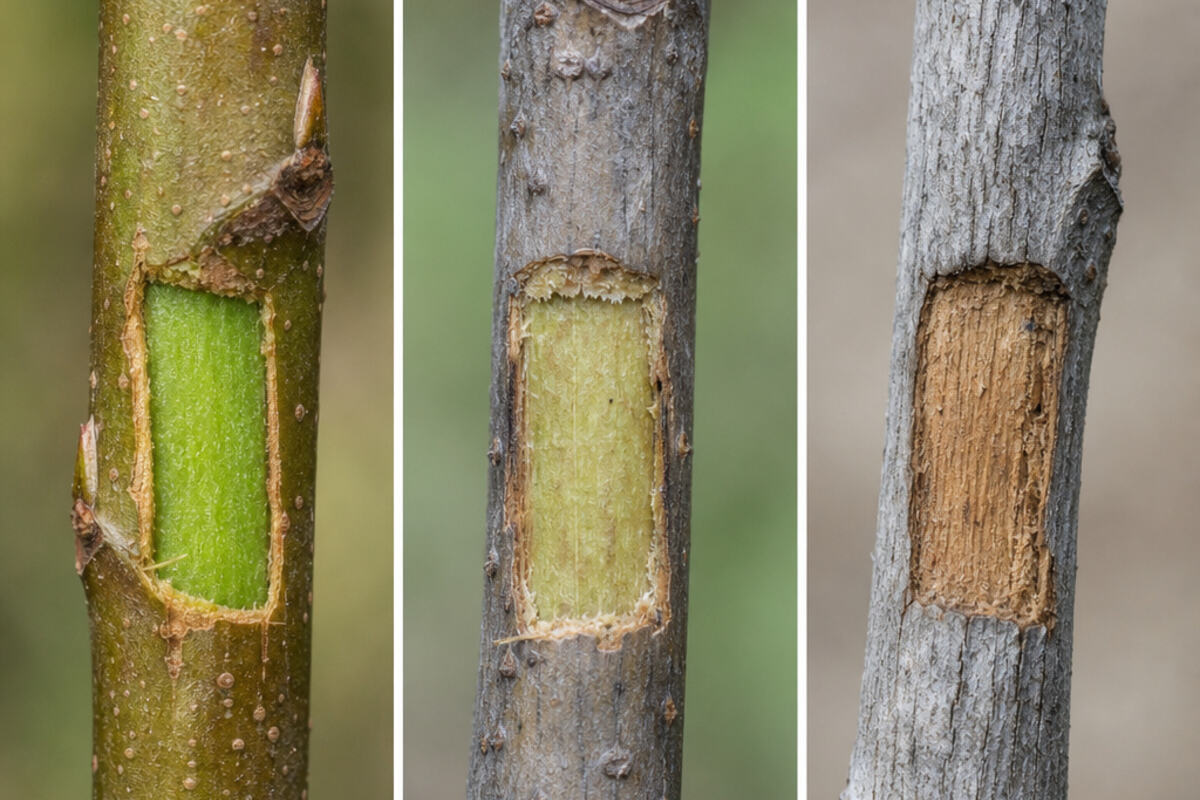
Scratch a pencil-thin twig with your thumbnail or a pocket knife, just deep enough to get under the bark. Green, slightly moist tissue underneath means the twig is alive. Brown, dry, and brittle means it is dead. The key is to test several twigs: five or six, from different sides of the tree and different heights you can reach. One dead twig means one dead branch. All dead twigs mean a dead tree. On a large tree you cannot reach the upper canopy, so combine this with what the leaves and bark are telling you.
Can a tree with no leaves still be alive?
In winter, yes; every deciduous tree looks dead from December to March, and a healthy oak can be one of the last to leaf out in spring. But in late spring or summer, a tree with no leaves, or leaves on only one side, is in serious trouble. Pinch a bud: a live bud is plump and slightly flexible, while a dead one is dry and crumbles. Evergreens are easier to read. Needles turning brown from the inside out is normal seasonal shedding; a whole evergreen going brown or losing needles from the top down is dying.
Do mushrooms at the base of a tree mean it is dying?
Usually yes, and this is the sign homeowners most often ignore because the tree looks fine above. Shelf or bracket fungi growing out of the trunk, and mushrooms coming up from the roots or the base, mean the wood inside is decaying. The tree can hold full green leaves for years while its base goes hollow, and then it fails in a storm from the bottom. Fungus on a large tree within falling distance of a house is a reason to have it assessed this season, not next year. If it is already leaning, read should I worry about a tree leaning toward my house?
Can a dying tree be saved?
Sometimes, if the cause is fixable. Drought stress, compacted soil from construction or parking, girdling roots strangling the trunk, or a pest that can be treated are all things an arborist can address, and the tree often recovers over a season or two. A tree with a hollow trunk, major root rot, or more than half its canopy dead usually cannot be saved, and spending money on treatment delays the removal you will need anyway. One arborist visit tells you which situation you have. Many will do a basic assessment at low cost, and it is a good idea to ask about it when you get a removal quote.
How long can a dead tree stand before it falls?
Anywhere from months to several years, depending on the species and how much rot it has. Soft woods like poplar, birch, and cottonwood break up fast. Oaks and locusts can stand dead for a long time. The problem is not the trunk; it is the limbs, which start dropping long before the trunk gives way, and a dead limb from 40 ft up will go through a roof. A dead tree in the back corner of a large lot can wait. A dead tree near the house, the driveway, or the neighbor's fence should not, both for safety and because your insurance can deny a claim for damage from a tree you knew was dead. See does homeowners insurance cover tree removal?
What does it cost to remove a dead tree?
Usually a bit more than a live tree of the same size, not less. Dead wood is brittle and unpredictable, so crews cannot climb it safely and often need a bucket truck or crane instead. A 60–80 ft dead tree near a house typically lands at the top of the $800–$1,500 range or above it. Full ranges by size are on how much does it cost to remove a tree?
No independently confirmed professional review is on file yet.
Not yet independently reviewed. Figures are typical US ranges for planning purposes, not quotes.