What's the difference between stump grinding and stump removal?
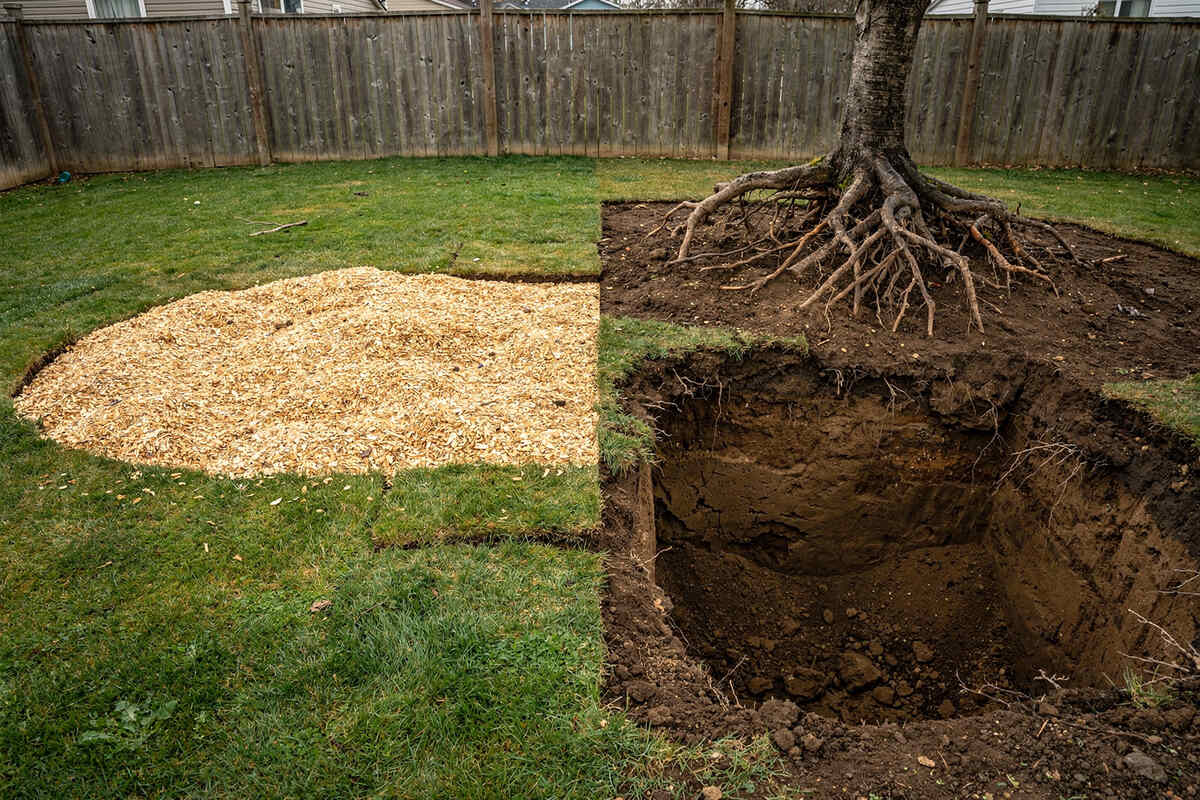
Stump grinding uses a machine to chip the stump down to 6–12 inches below ground and leaves the roots to rot. Stump removal digs or pulls out the entire stump and root ball. Grinding costs $100–$400 and takes under two hours; removal costs $300–$1,000+, takes half a day, and leaves a big hole. Most homeowners want grinding.
Companies use "stump removal" for both jobs, which is why a quote can come in hundreds of dollars higher or lower than expected for what sounds like the same thing. They are not the same thing. One takes the stump down below the surface and walks away. The other takes the stump out of the ground entirely. Here is how they compare.
| Stump grinding | Stump removal (excavation) | |
|---|---|---|
| How it is done | A grinder with a spinning carbide wheel chips the stump into mulch | Roots are cut, the stump is pried or pulled out, usually with an excavator or a truck and chain |
| How deep | 6–12 inches below ground; deeper on request | 12–24 inches plus the main roots |
| What happens to roots | Left in place to rot over 3–10 years | Main roots removed; small feeder roots stay |
| Cost | $100–$400 per stump ($2–$5 per inch of diameter) | $300–$1,000+ per stump |
| Time on site | 15 minutes to 2 hours | Half a day or more |
| Damage to yard | Minimal; machine fits through a gate | Significant; excavator tracks, large hole, spoil pile |
| What is left | Chip mound in a shallow depression | A hole that needs several yards of fill |
| Can you plant grass right after? | Yes, after removing chips and adding topsoil | Yes, after backfilling and settling |
| Can you build on it right after? | No; roots and chips will settle | Yes, once properly compacted |
| Do-it-yourself option | Rent a grinder, $150–$400 a day | Dig by hand (small stumps) or rent an excavator |
Does stump grinding remove the roots?
No, and this is the fact that decides most of the questions on this page. Grinding removes the visible stump and the top 6–12 inches of it. Everything below that, including the big lateral roots that spread as far as the branches did, stays in the ground. Those roots are dead once the stump is gone. They cannot feed themselves without leaves, so they decay over 3–10 years and become soil. The exception is a handful of species that sprout from roots, such as willow, poplar, cottonwood, elm, silver maple, black locust, and tree of heaven; those can send up shoots for a few seasons and need to be cut or treated. More on that in should I just leave the stump?
When do you need full stump removal instead of grinding?
When something will be built on or through that spot. A foundation, driveway, patio, pool, retaining wall, septic line, or utility trench cannot go over a mass of rotting roots, because the ground will settle as they decay. Builders will require full removal, and it is often folded into the site-prep contract. The other case is planting: if you must put a new tree in the exact same place right away, removal gives it clean soil. If you can wait about a year or shift 3 ft over, grinding is fine; see can I plant where a stump was ground? For everything else, including lawns, gardens, and appearance, grinding is the better choice.
Why is stump removal so much more expensive than grinding?
Equipment and labor. A stump grinder is a compact machine that one operator rolls through a gate and runs for an hour. A full removal means cutting every root, then breaking the stump loose with an excavator, a skid steer, or a truck and chain, then lifting a root ball that can weigh as much as a car, hauling it away, and backfilling the crater with several yards of soil. It is a small earthmoving job. That is why it runs $300–$1,000+ per stump against $100–$400 for grinding, and why the price climbs fast with stump diameter. Full pricing is on how much does stump grinding or removal cost?
What is left after stump grinding?
A mound of wood chips mixed with soil, roughly the volume of the stump, sitting in and around a shallow depression. Most grinding quotes leave the chips for you. You rake them out (they make decent mulch for paths or beds), fill the hole with topsoil, tamp it, and seed. The ground will settle a little over the next year as the roots below decay, so a second top-up of soil is normal. Pros will rake, haul, and backfill for an extra $50–$150 if you ask when you book.
Can you grind a stump after it has been in the ground for years?
Yes, and old stumps are the easy ones. A stump that has been rotting for a few years is softer and grinds in a fraction of the time. Grinders handle stumps of any age and any diameter, since a large stump is just more passes. The real limits are access, meaning whether the machine can reach the stump through gates and past fences, and what is hidden in the stump: rocks, old fence wire, or nails will stop the job while the operator digs them out, and some companies charge extra for it.
How does this relate to the tree removal quote?
Tree removal quotes almost never include either one. The crew cuts the tree to a low stump, 6–12 inches high, and the stump is a separate line item, sometimes done by a different company with different equipment. If you want the stump gone, ask for grinding as a line item when you get the removal quote, and expect it to add $100–$400. What else is and is not included is on can I keep the wood? What does tree removal include?
No independently confirmed professional review is on file yet.
Not yet independently reviewed. Figures are typical US ranges for planning purposes, not quotes.