Mushrooms or fungus on my tree or roots — is that bad?
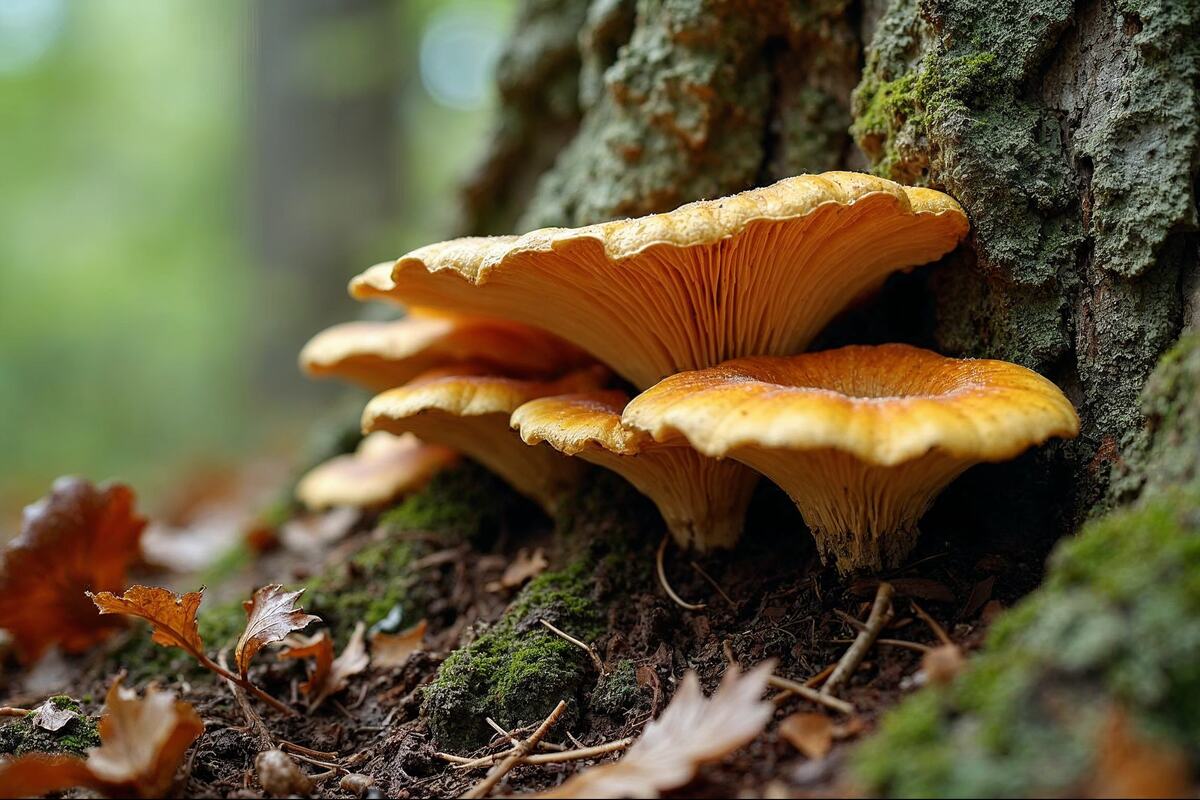
It depends where the fungus grows. Mushrooms coming up from the base of the trunk or along the roots mean those roots are decaying. Shelf fungus on the trunk means internal rot. Both call for an arborist. Lichen and moss on bark are harmless, and mushrooms scattered in the lawn are usually feeding on old roots, not the tree.
Fungus is everywhere in a yard, and most of it is harmless. The kind that matters eats wood, and the only time you see it is when it sends up a mushroom or a shelf, the last stage of a process that has been going on inside the tree for years. The question is never whether the fungus is bad, but where it is growing and what it is growing on.
| What you see | Where | What it usually means | What to do |
|---|---|---|---|
| Mushrooms growing from the trunk base or root flare | Base of a living tree | Root or butt rot; base may be hollow | Arborist assessment, especially near a house |
| Mushrooms in a line or cluster along a root | Lawn, following a root outward | That root is decaying | Arborist assessment |
| Honey-colored mushrooms in clumps at the base, white fans under bark | Base, several trees in an area | Armillaria root rot | Arborist; often not treatable |
| Shelf, bracket, or hoof-shaped fungus | On the trunk or a large limb | Internal decay, often extensive | Arborist; may mean removal |
| Gray-green, flat, crusty or leafy patches | Bark, any tree | Lichen; harmless | Nothing |
| Green fuzzy mat | Shaded side of bark | Moss; harmless | Nothing |
| Mushrooms scattered in the lawn, not attached to the tree | Lawn, after rain | Feeding on thatch, buried wood, or old roots | Nothing; mow them |
| Mushrooms on a stump or an old grinding site | Dead wood | Normal, useful decay | Nothing |
Do mushrooms at the base of a tree mean it is dying?
Usually they mean the base or roots are decaying, which is different from a tree dying and in some ways worse. A tree with root rot can carry a full green canopy for years, because the outer ring of wood that moves water is the last part to go. What it loses is the wood that holds it up, and the failure comes at the base in a storm. That is why the checklist on how do I know if my tree is dead or dying? lists fungus at the base as a hazard sign rather than a health sign. The size of the tree and what it would hit decides how urgent it is. A crabapple in the back corner can be watched. A 60 ft oak leaning over the bedroom cannot.
What does shelf fungus on a tree trunk mean?
Shelf, bracket, and conk fungi are the fruiting bodies of fungi that decay the wood inside a trunk or limb. By the time a shelf appears the fungus has been at work for years, and the visible part tells you nothing about how far the rot extends. Some species hollow a trunk while leaving a thick, sound shell that can stand for decades. Others leave the wood brittle. An arborist sounds the trunk with a mallet, probes cavities, and in doubtful cases uses a resistance drill to map how much solid wood is left. You cannot judge that by looking, and it is the main thing you pay for on a consultation visit.
Is lichen or moss on a tree harmful?
No, and this is the most common false alarm. Lichen is a fungus and an alga living together on the bark surface, making their own food from sunlight and taking nothing from the tree. It grows on rocks and fences as readily as on trees. Moss is a plant doing the same thing on the damp, shaded side of a trunk. Neither needs scraping or spraying, and scraping damages bark. Heavy lichen is more common on slow-growing or thinning trees because the bark stays put longer and gets more light, so it can be a sign that the tree is not vigorous; it is never the reason. If a lichen-covered tree is thinning, look for the real cause in watering, soil compaction, or one of the common tree diseases.
Are mushrooms in the lawn near a tree a problem?
Usually not. Lawn mushrooms come up after rain wherever there is something dead to eat: thatch, buried lumber, old roots from a tree removed years ago, or a ground stump. They are decomposers doing normal work and vanish in a few days. The pattern to take seriously is mushrooms growing in clumps right against the trunk of a living tree, or in a line that follows a root out from the base. Honey-colored clumps at the base of several trees in one area, with white fan-shaped sheets under the bark when you pull a piece off, is Armillaria, a root rot that spreads tree to tree through the soil and has no practical cure.
When should I call an arborist about fungus?
Call when fungus is growing from a living tree, at the base, roots, or trunk, and the tree is big enough and close enough to hit a house, driveway, play area, or street. Call sooner if it comes with a thin canopy, dead limbs, a crack, or a lean. Do not bother for lichen, moss, lawn mushrooms, or growth on a stump. A basic arborist visit costs $75–$150. You will hear one of three things: the decay is minor and can be monitored, the tree can be kept with weight reduction and periodic inspection, or the base is too far gone and the tree should come down while you still choose the direction. The cost of a planned removal is on how much does it cost to remove a tree?
No independently confirmed professional review is on file yet.
Not yet independently reviewed. Figures are typical US ranges for planning purposes, not quotes.